This site is paid for by Invest in Education Coalition, a public charity organized as a 501(c)(4)
Privacy Policy
Terms Of Use
Press Contact: press@investineducation.org
Privacy Policy
Terms Of Use
Press Contact: press@investineducation.org

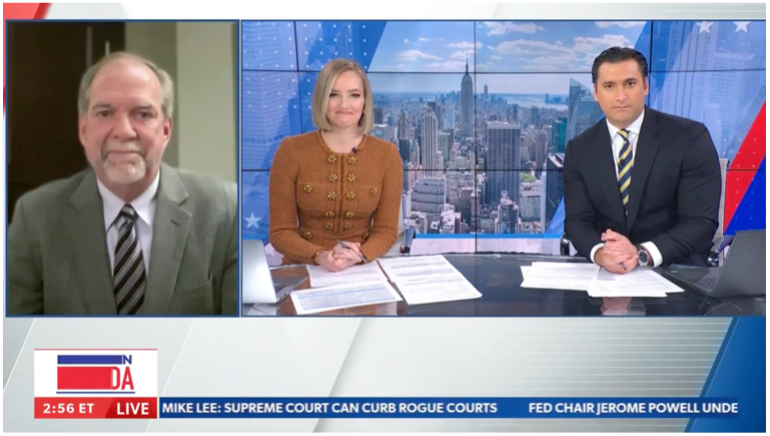
WASHINGTON, DC – In case you missed it, Peter Murphy, Vice President of Policy for Invest in Education Coalition, joined Newsmax yesterday to discuss his op-ed highlighting the new federal tax credit scholarship program. The program will enable parents of millions of K-12 students across the country to access a school or education service of their choice in the years ahead.
The op-ed explains how students will be able to access these scholarships; however each Governor must opt in by January 1, 2027 for the students in the state to benefit. The donated scholarship funds could be used by families to pay for tuition, tutoring, special needs services and education technology, among other eligible uses.
CLICK HERE TO WATCH THE INTERVIEW
Governors Should Grab Tax Credits for K-12 Scholarships
A new federal tax credit scholarship law will provide a windfall of new money to fund children’s scholarships for K-12 expenses, regardless of where they attend school.
To make this scholarship money available to children, it is up to each state’s governor to decide if the tax credit will apply to their respective states.
Last summer, President Trump and the U.S. Congress included the first nationwide school choice law as part of the budget reconciliation law that will help children in all K-12 school settings, public, private, charter, or religious.
That means more, not less, funding for K-12 education.
A wrinkle in this new law, which takes effect in 2027, is that each of the nation’s 50 governors must annually decide if this law, and the billions of charitable dollars that would result, will benefit children in their respective states — informally known as the “opt-in” guidance from the Internal Revenue Service (IRS) on this process was issued earlier in December and more is expected soon.
For each state’s children, the “buck” literally stops with the governor.
If each governor “opts in” to this federal tax credit scholarship law, up to $24 billion annually in additional charitable donations from individuals would accrue, according to an analysis by Democrats for Education Reform.
The resulting scholarship money would make educational options and supplemental services affordable for many more families to use for tuition, tutoring, special needs, after-school programming and much more, irrespective where they attend school.
If a governor refuses to opt in, due to opposition to school choice, millions of that state’s taxpayers may donate up to tens of millions worth of scholarship funds to states with governors that do opt-in — meaning, children in other states will benefit.
One of those states is Colorado, where Democratic Gov. Jared Polis last month stated he would let the federal law take effect.
The tax credit scholarship law “is a real boom of investment in kids,” he said.
“It supports donors to give more money to our schools; I mean, I would be crazy not to” opt the state into the program. North Carolina’s Democratic Gov. Josh Stein last summer indicated that he would do likewise, recognizing the tax credit would benefit public school students.
The federal scholarship law is unique in that it is a 100% credit against individual income taxes for donations of up to $1,700 per year to not-for-profit scholarship granting organizations (SGO).
This dollar-for-dollar incentive means that a donation to an SGO in a state that opts in would cost the donor nothing.
Either the individual taxpayer pays Uncle Sam’s treasury or donates up to this maximum to support children in K-12 education.
For those states that face budget gaps where budgeted spending exceeds revenue, such as the multi-billion dollar gaps in California and New York, the merits of opting in to this federal law to generate potentially billions more in education funding directly to families are clear.
Opting in to the federal tax credit could forgo potential state tax hikes.
While the federal tax credit scholarship taking effect in the states is a no-brainer, one of the most politically powerful interest groups, the teacher unions, is knee-jerk opposed.
The rub is that teacher unions will reject substantial new funding from the tax credit for children in public schools if a single child stands to obtain a scholarship to access a private school alternative.
Indeed, more important to teacher unions than new money is its monopolistic control over K-12 education.
Since the federal tax credit scholarship law also would enable families to financially access private and religious schools, teacher union leadership will oppose any state “opt-in” to the federal law, notwithstanding its major windfall for children and teachers in public education.
And, what of the school boards and superintendents?
Will they also deny their district students additional resources?
Governors have a decision before them, especially in states that have opposed school choice: help all children with billions in private donations with no loss to state or school district budgets or side with the teacher unions and the system they want to remain in control over.
Governors throughout the country have overcome the teacher union opposition to pass state school choice laws.
Those governors traditionally in opposition to choice should follow those examples by letting the federal tax credit scholarship law take effect so that their state’s taxpayer-donors can benefit their own states’s school children.
To learn more, please visit investineducation.org.
About Invest in Education Coalition
Invest in Education Coalition is a 501(c)(4) organization that advocates at the federal level to protect and expand the federal tax credit scholarship law that will directly empower parents of students in K-12 education throughout the nation to choose the best school or education service for their children.
###
Treasurer and Secretary, Invest in Education Foundation
Partner, Educate, LLC
Bob founded Educate with Frank Hardart because they shared a vision and saw a problem. The vision: every child in every school deserves a chance to succeed. The problem: teachers were equipped with technology, but lacked the support to use it and transform education. Digital tools are more affordable than ever—but schools need guidance to realize their potential. As one of two partners at Educate, Bob works with school leaders to realize these goals and define the process of tech coaching, while supporting coaches and managing the company’s internal organization.
Coming from the corporate finance worlds of Merrill Lynch and JP Morgan, Bob knows that teamwork is essential to accomplishing anything meaningful. As a father of four freewheeling children, he knows that every single student is someone’s beloved child. Raised in Westchester County, Bob lives there today with his wife and kids, where he enjoys hiking, fishing, camping, and exploring the outdoors.
Invest in Education Foundation
Executive Director, Inner-City Scholarship Fund, Inc.
Susan George is a nationally recognized nonprofit leader who is passionate about providing aid and opportunities for individuals in need. She currently serves as Chief Advancement and Stewardship Officer at the Archdiocese of New York, overseeing development initiatives that raise over $50 million annually to support the Church of New York, the Alfred E. Smith Foundation, Catholic education, and underserved communities.
In her previous role, Susan was the Executive Director of the Office of Catholic Education Advancement and Inner-City Scholarship Fund, where she raised over $500 million and launched a capital campaign for a scholarship program that supports 8,000 inner-city children annually.
In addition to her role in education, she has worked closely with the Archbishop of New York and his senior management to plan two Papal visits to the city of New York.
Susan has transformed the board of three organizations through her ability to connect alumni and business leaders with the mission of their colleges and education. Today she manages a board of over 30 individuals including many leaders from Fortune 500 companies.
Prior to joining the archdiocese, Susan was at Teachers College, Columbia University where she was a Director of Major Gifts and initially an Associate Director of Major Gifts and Stewardship. There she managed relationships with trustees and other key volunteers. She was instrumental in recruiting new trustees to the College.
Susan’s first role in philanthropy began at Drew University when she assumed the role of Events Coordinator and then advanced to Associate Director, Leadership Gifts.
She holds a B.A. from the University of Connecticut and a Master of Letters from Drew University where her thesis was “Corporate Philanthropy.”
Susan currently serves or has served on the boards of The Hawthorne Foundation, Inner-City Scholarship Fund, Invest in Education Foundation, and Regis High School.
Invest in Education Foundation
President and COO, Children’s Scholarship Fund
Darla Romfo serves as President and Chief Executive Officer of the Children’s Scholarship Fund, a nonprofit dedicated to providing partial scholarships for low-income children in grades K-8 to go to private school. CSF’s motto is to give parents a choice and children a chance. In bringing that motto to life, CSF has provided scholarships worth approximately $1 billion to more than 209,700 children since its inception in 1998 and currently serves more than 33,900 children nationwide. Ms. Romfo has served in this capacity since the organization offered its first scholarships in 1999.
Ms. Romfo is a frequent speaker on education and parental choice, appearing often on Fox News and other media outlets, advocating for all parents to have the right to choose the best educational pathways for their children. She is on the boards of the Drexel Fund, Brilla College Prep Charter Schools, the Invest in Education Coalition, The Cloisters on the Platte, and Silvercrest Asset Management Group.
Ms. Romfo grew up on a farm in North Dakota and graduated from the University of North Dakota with degrees in political science and accounting. She is a CPA and received a law degree from George Washington University.
Secretary, Invest in Education Coalition
Chief Executive Officer, Bluff Point Associates
Thomas E. McInerney is the Chief Executive Officer and Co-Founder of Bluff Point Associates, a private equity investment company focusing on small and mid-sized companies in the fintech and healthcare information processing sectors.
Previously, Mr. McInerney was a General Partner at Welsh, Carson, Anderson & Stowe (WCAS), one of the larger private equity investment firms in the U.S. Mr. McInerney specialized in WCAS activities in the information services and telecommunications industries. As his first responsibility at Welsh Carson, Mr. McInerney served as President and CEO of Momentum Technologies, Inc., a New Jersey-based privately-owned provider of computer systems and services. The company later went public as DecisionOne Corporation and became the largest independent computer maintenance company in the U.S. before it was sold. During his 23 years at the firm, Mr. McInerney led the acquisition of dozens of companies, took many of them public and served as CEO of several of them.
Before joining WCAS, Mr. McInerney served as the President and Chief Executive Officer at Dama Telecommunications Corporation, which he co-founded in 1982. He has also served as President of Automatic Data Processing’s (ADP) Brokerage Services Division and then as Group Vice President – Financial Industry Services, ADP’s second-largest business unit. Mr. McInerney also served as the Senior Vice President, Operations and Technology at the American Stock Exchange where he was responsible for all trading floor, clearing corporation and technology operations.
Mr. McInerney received a Bachelor of Arts degree from St. John’s University in 1964 and attended NYU Graduate School of Business from 1965-1968.
He currently serves as the Chair of the Board of Directors of the Bread and Life Program, as a board member of the Manhattan Institute for Policy Research in NYC and as Chair of the Foundations in Education Board for the Diocese of Bridgeport, CT. He is a former member of the Investment Committee for the Eastern Province of the Congregation of the Mission and a past member of the board of the Institute for Catholic Schools.
Treasurer, Invest in Education Coalition
Robert H. Niehaus is the Chairman and Founder of GCP Capital Partners LLC, an independent, privately held investment management firm which currently manages four U.S. private equity funds totaling $1.8 billion in committed capital. GCP has had a successful track record investing $1.6 billion in approximately 68 portfolio companies. Mr. Niehaus formed GCP Capital Partners in 2009 as the successor to Greenhill Capital Partners, the merchant banking business of Greenhill & Co., Inc. (NYSE: GHL). Mr. Niehaus joined Greenhill & Co. in 2000 to begin the formation of Greenhill Capital Partners and served as its Chairman and Chair of its Investment Committee from 2000 to 2009.
Prior to joining Greenhill in 2000, Mr. Niehaus spent 17 years at Morgan Stanley & Co., where he was a Managing Director in the merchant banking department from 1990 to 1999. Mr. Niehaus was Vice Chairman and a Director of the Morgan Stanley Leveraged Equity Fund II, L.P., a $2.2 billion private equity investment fund, from 1992 to 1999 and was Vice Chairman and a Director of Morgan Stanley Capital Partners III, L.P., a $1.8 billion private equity investment fund, from 1994 to 1999. Mr. Niehaus was also Chief Operating Officer of Morgan Stanley’s merchant banking department from 1996 to 1998.
Mr. Niehaus is Chairman of Iridium Communications, Inc. (NASD: IRDM), and is a director of several private GCP portfolio companies. Mr. Niehaus is a Trustee of the Cystic Fibrosis Foundation and chairs its Investment Committee which oversees a $5.4 billion endowment. Mr. Niehaus also chairs the New York Catholic Foundation and is a Board Member of the Asia Society, the Jesuit Refugee Services USA, Mother Cabrini Health Foundation, Student Sponsor Partners, and Success Academy Charter Schools. Mr. Niehaus is a graduate of Princeton University (1977) and the Harvard Business School (1982), from which he graduated with high distinction as a Baker Scholar.
Chairman of the Board, Invest in Education Coalition
Chairman, Welsh, Carson, Anderson & Stowe
Anthony J. de Nicola is Chairman of Welsh, Carson, Anderson & Stowe, a New York private investment firm, which manages over $31 billion in its various funds. Mr. de Nicola joined WCAS in 1994, he has served on the firm’s Management Committee since 2000, he was appointed President in 2007 and Chairman in 2021. Mr. de Nicola has led the firm’s investment activities in the technology industry and has been involved with some of the firm’s most successful and profitable investments. He serves on the board of directors for a number of the firm’s private and public companies. Prior to joining WCAS, Mr. de Nicola worked in the private equity group at William Blair & Company and the merger department at Goldman Sachs & Co.
Mr. de Nicola earned his BA degree from DePauw University, where he graduated summa cum laude with an economics major and a minor in computational mathematics. Mr. de Nicola also earned an MBA with distinction from the Harvard Business School.
Mr. de Nicola and his wife Christie have been married for over 35 years and are active members of the community including their extensive philanthropic work, with a focus on education, poverty relief, healthcare and supporting the Catholic Church. Mr. de Nicola serves on several non-profit boards including The Hospital for Special Surgery, The Partnership for New York City, Invest in Education Coalition, The Inner-City Scholarship Fund and The Catholic Foundation for the Archdiocese of New York. He is also a member of the Finance Committee and the Pension Investment Committee for the Archdiocese. He is a founding board member of Brilla College Prep, a public charter school in the Bronx. Previously, he served on the Board of Trustees and the Investment Committee of DePauw University.
Tony and his wife, Christie, are the proud parents of three children and four grandchildren.